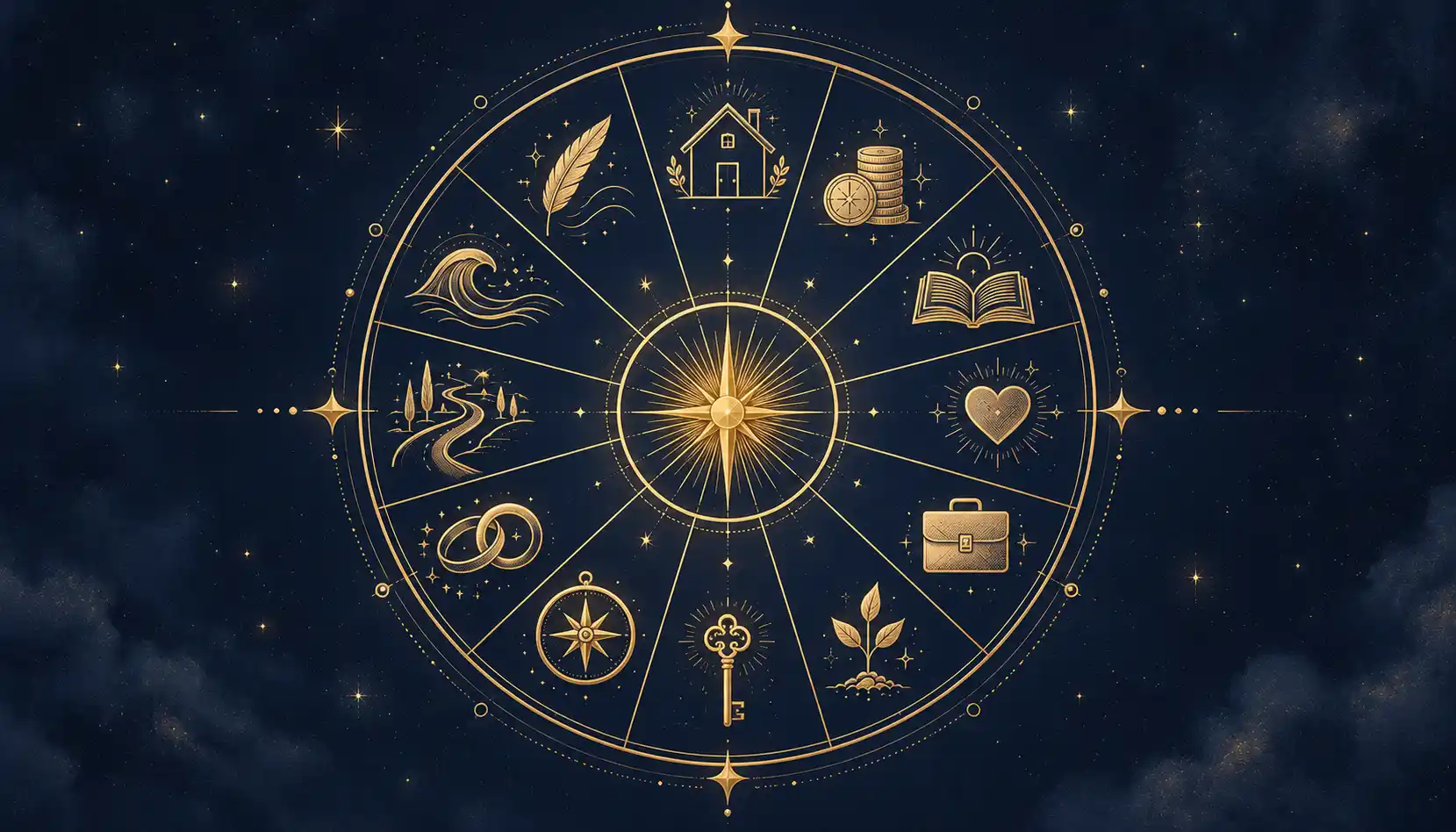
The 12 houses (bhav or bhava) divide a Vedic birth chart into 12 areas of life. The 1st is self, the 2nd wealth and family, the 3rd courage and siblings, the 4th home and mother, the 5th children and creativity, the 6th health and obstacles, the 7th marriage, the 8th transformation, the 9th fortune, the 10th career, the 11th gains and the 12th loss and release.
If the nine planets are the actors, the houses are the parts of life where each actor performs. The 1st house always starts at your lagna.
What does each of the 12 houses mean?
| House | Sanskrit name | Main themes | Body area |
|---|---|---|---|
| 1st | Tanu | Self, body, personality, overall life direction | Head |
| 2nd | Dhana | Money, family, speech, food, values | Face, mouth |
| 3rd | Sahaja | Siblings, courage, effort, communication, short trips | Shoulders, arms |
| 4th | Bandhu / Sukha | Home, mother, property, vehicles, inner peace | Chest, heart |
| 5th | Putra | Children, creativity, intelligence, romance, past merit | Stomach |
| 6th | Ari / Ripu | Health, enemies, debts, daily work, service | Intestines |
| 7th | Yuvati / Kalatra | Marriage, partners, business deals, the public | Lower abdomen |
| 8th | Randhra / Ayu | Change, crisis, longevity, hidden matters, research | Reproductive organs |
| 9th | Dharma | Luck, father, teachers, higher learning, beliefs | Thighs |
| 10th | Karma | Career, status, actions, reputation | Knees |
| 11th | Labha | Income, gains, friends, networks, wishes fulfilled | Calves |
| 12th | Vyaya | Expenses, loss, foreign lands, sleep, letting go | Feet |
There is a story running through the order. Read 1 to 12 and the houses roughly follow a life: birth, family, early exploration, home, school, the first conflicts, partnership, upheaval, purpose, career, rewards and finally release.
What are kendra, trikona and dusthana houses?
Astrologers rarely judge houses one at a time. They group them:
| Group | Houses | Meaning | Planets here tend to… |
|---|---|---|---|
| Kendra (angles) | 1, 4, 7, 10 | Pillars of the chart: self, home, partnership, career | Act visibly and strongly |
| Trikona (trines) | 1, 5, 9 | Houses of fortune and merit | Bring ease and grace |
| Dusthana (difficult) | 6, 8, 12 | Obstacles, upheaval, loss | Work through struggle or service |
| Upachaya (growth) | 3, 6, 10, 11 | Areas that improve with effort and age | Get better over time |
The 1st house is both a kendra and a trikona, which is one reason the lagna is weighed so heavily.
Two practical rules come out of this:
- Kendras and trikonas are the "support beams". When their lords are strong and linked to each other, astrologers call the combination a raja yoga.
- Malefics like Saturn and Mars often do well in upachaya houses (3, 6, 10, 11), because those areas reward grit.
Are the 6th, 8th and 12th houses bad?
Not in the way people fear. The dusthanas cover hard topics (illness, debt, crisis, loss), but each has a constructive side:
- 6th house: problem-solving, healthcare, law, competitive exams, service work. Many doctors, lawyers and analysts have a strong 6th.
- 8th house: research, psychology, insurance, inheritance, astrology itself, and the ability to rebuild after a crisis.
- 12th house: spirituality, foreign settlement, hospitals, charity, rest, and spending on things that matter.
A planet in a dusthana usually means that part of life comes with effort or unusual circumstances, not that it is doomed.
How do houses connect to each other?
Every house can be read as a starting point. Counting from it gives "derived houses":
- The 7th from the 7th is your 1st house, so partnership mirrors self.
- The 4th from the 4th (your 7th) shows your mother's mother's side in some traditions.
- The 9th is the 3rd from the 7th: your spouse's siblings.
You don't need this on day one. It does explain why experienced astrologers can say a lot from a single placement: one house holds many layers.
How do you read a house in your chart?
For any house, check:
- Which sign is on it, which sets the tone.
- Where its lord sits, which shows where those themes get sent. Here is where most of the action is.
- Which planets occupy it, and whether they're friendly to that house's themes.
- Which planets aspect it, since outside influences change the result.
An empty house is not an empty life area. It simply means the house is read through its lord and aspects instead of through occupants.
Frequently asked questions
Which house is for marriage in Vedic astrology?
The 7th house is the main house for marriage and committed partnership in Vedic astrology. Astrologers also check the 2nd house (family life), the 8th (longevity of marriage and in-laws), Venus as the significator of love, and the Navamsa (D9) chart before saying anything about marriage.
Which house is for career?
The 10th house is the primary house of career, status and public reputation. The 6th house (daily work and service) and the 2nd and 11th houses (earnings and gains) complete the picture, along with the Dashamsha (D10) divisional chart.
What does an empty house mean in a kundli?
An empty house in a kundli has no planets sitting in it, but its themes are still active. They are read through the house lord's placement and through any planets aspecting the house. Every chart has at least three empty houses, since nine planets can't fill twelve houses.
What is the strongest house in a birth chart?
The 1st house (lagna) is usually considered the strongest single house, because it is both a kendra and a trikona and represents the self. The kendras (1, 4, 7, 10) as a group are the chart's pillars of visible strength.