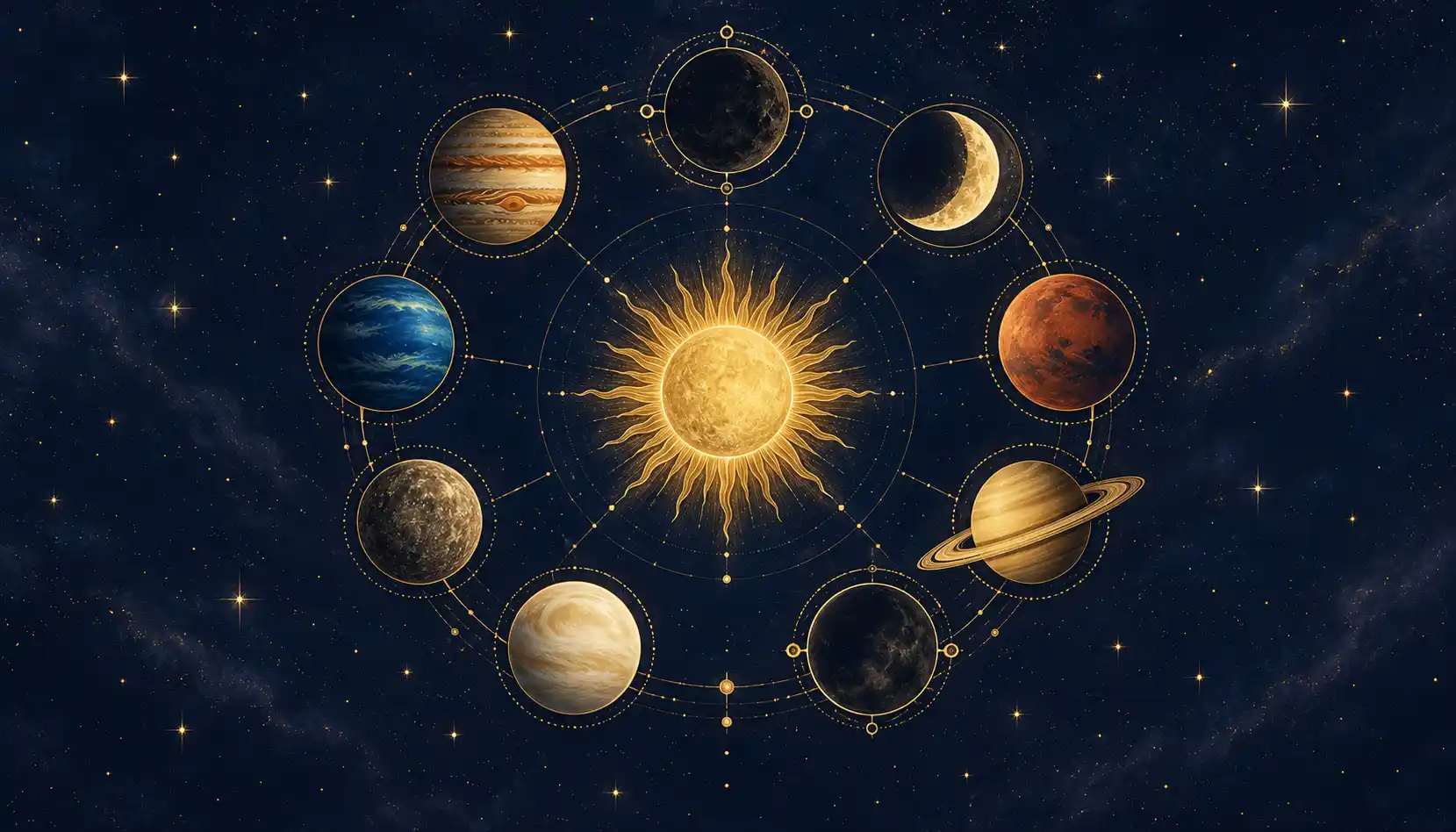
The navagraha are the nine "planets" (grahas) of Vedic astrology: Sun, Moon, Mars, Mercury, Jupiter, Venus, Saturn, Rahu and Ketu. Each one stands for a part of human experience. The Sun stands for identity, the Moon for the mind, Mars for drive, Mercury for intellect, Jupiter for wisdom, Venus for love and comfort, Saturn for discipline, Rahu for desire and Ketu for detachment.
They are the main actors in any kundli. Houses are the stage, and signs are the costumes.
Why are the Sun, Moon, Rahu and Ketu called planets?
"Graha" literally means that which grasps or seizes, meaning something that takes hold of us. It isn't an astronomical category. The Sun is a star, the Moon is a satellite, and Rahu and Ketu are not physical bodies at all. They are the two points where the Moon's orbit crosses the Sun's apparent path, which is why eclipses happen near them. Jyotish groups all nine together because all nine are used to track human experience, not because they are astronomically alike.
Uranus, Neptune and Pluto are not part of the classical system.
What does each of the nine planets mean?
| Graha | Hindi name | Represents | Rules | Natural nature |
|---|---|---|---|---|
| Sun | Surya | Self, identity, authority, father, vitality | Leo | Malefic (mild) |
| Moon | Chandra | Mind, emotions, mother, comfort | Cancer | Benefic when waxing |
| Mars | Mangal | Energy, courage, conflict, siblings, property | Aries, Scorpio | Malefic |
| Mercury | Budh | Intellect, speech, trade, learning, humour | Gemini, Virgo | Benefic (takes on company) |
| Jupiter | Guru | Wisdom, teachers, growth, children, fortune | Sagittarius, Pisces | Strong benefic |
| Venus | Shukra | Love, marriage, beauty, art, comfort | Taurus, Libra | Benefic |
| Saturn | Shani | Time, discipline, work, delay, endurance | Capricorn, Aquarius | Malefic |
| Rahu | Rahu | Obsession, ambition, the foreign or unconventional | No sign (shadow planet) | Malefic |
| Ketu | Ketu | Detachment, intuition, loss, spirituality | No sign (shadow planet) | Malefic |
What do "benefic" and "malefic" actually mean?
The classical texts sort planets into natural benefics (saumya: Jupiter, Venus, a well-lit Moon, and Mercury when it isn't with malefics) and natural malefics (krura: Saturn, Mars, Sun, Rahu, Ketu and a dark Moon).
This label tells you the planet's natural flavour. It does not tell you whether the planet is good or bad for you. Three things change the picture:
- Which houses the planet rules in your chart. Saturn is a natural malefic, but for Taurus and Libra lagnas it rules some of the best houses in the chart and often becomes the single most helpful planet. Astrologers call this a functional benefic.
- Its strength and dignity. A planet in its own or exalted sign works more cleanly.
- Its company. Conjunctions and aspects from other planets change the result.
Malefic planets are also the ones that build things. Saturn is behind patience and long careers, and Mars is behind the courage to start something. A chart with no malefic influence at all tends to belong to someone who is comfortable but rarely tested.
Rahu and Ketu, the shadow planets
Rahu and Ketu always sit exactly opposite each other in a chart, which makes them an axis rather than two separate planets.
- Rahu points to what you are hungry for: the unfamiliar, the ambitious, the thing that never feels like enough. It can produce sudden rises, foreign connections and unconventional careers, and also restlessness.
- Ketu points to what you already know too well to care about. It is linked to detachment, intuition, research, spirituality and sometimes a sense of loss or disinterest in that area of life.
Together they sketch a pull between where you're heading (Rahu) and what you're leaving behind (Ketu). Many astrologers read the Rahu–Ketu house axis as one of the main themes of a life.
How do you read a planet in your own chart?
For any graha, ask four questions in order:
- Which house is it in? That's where its energy shows up.
- Which houses does it rule? It carries those themes wherever it goes.
- What sign is it in? That sets its comfort level and style.
- Who is it with or aspected by? That changes the tone.
Then ask when it matters. A planet's themes come to the foreground during its own dasha period, which a later post in this series covers.
Frequently asked questions
Which planet is the most important in Vedic astrology?
Vedic astrology usually treats the Moon as the most important single planet for day-to-day experience, because it represents the mind. In a specific chart, the lagna lord and the strongest planet by strength calculations often matter more than any general ranking.
Is Saturn always bad?
Saturn is not always bad. It is a natural malefic, which means it slows things down and asks for effort, but for some lagnas (notably Taurus and Libra) Saturn rules excellent houses and acts as the chart's most helpful planet. Saturn periods are often when people build lasting careers.
Why are Rahu and Ketu always opposite each other?
Rahu and Ketu are the two points where the Moon's orbit crosses the ecliptic, the Sun's apparent path. Those two crossing points are always 180 degrees apart, so Rahu and Ketu always sit in opposite signs and houses in every kundli.
Do Uranus, Neptune and Pluto matter in Vedic astrology?
Traditional Vedic astrology uses only the nine grahas and does not include Uranus, Neptune or Pluto. Some modern practitioners add the outer planets, but classical methods like the dasha system have no place for them.