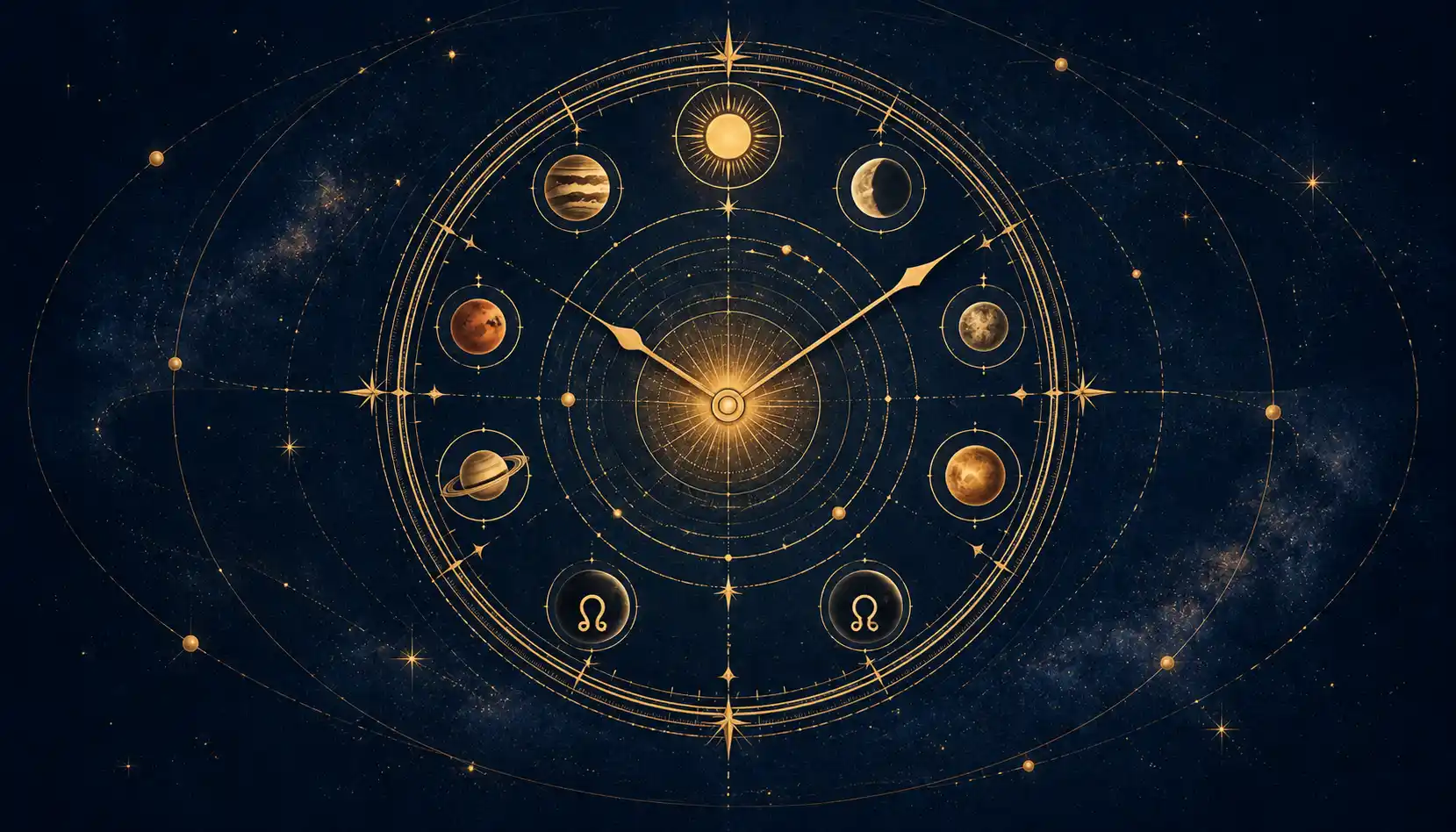
Vimshottari dasha is Vedic astrology's main timing system. It divides a 120-year cycle into nine planetary periods (mahadashas) that run in a fixed order: Ketu 7 years, Venus 20, Sun 6, Moon 10, Mars 7, Rahu 18, Jupiter 16, Saturn 19 and Mercury 17. The Moon's nakshatra at your birth decides which period you start in and how much of it is left.
A kundli describes potential. The dasha tells you which part of that potential is in the foreground right now.
What is a dasha?
"Dasha" means state or condition. In astrology it means a stretch of time ruled by one planet. During that planet's period, whatever it represents in your chart becomes more active and more visible: the houses it sits in, the houses it rules, and the planets it's linked to.
Think of your chart as a house with nine rooms. All the rooms exist all the time, but the dasha decides which room the lights are on in.
How many years does each planet's dasha last?
| Order | Planet | Mahadasha length |
|---|---|---|
| 1 | Ketu | 7 years |
| 2 | Venus | 20 years |
| 3 | Sun | 6 years |
| 4 | Moon | 10 years |
| 5 | Mars | 7 years |
| 6 | Rahu | 18 years |
| 7 | Jupiter | 16 years |
| 8 | Saturn | 19 years |
| 9 | Mercury | 17 years |
| Total | 120 years |
The order never changes. After Mercury, the cycle returns to Ketu. Most people live through five to seven mahadashas in a lifetime, and nobody experiences all nine in full, because everyone starts partway through one.
How is your starting dasha decided?
This is where the nakshatras (lunar mansions) come in. The zodiac is divided into 27 nakshatras, each ruled by one of the nine planets in the same Vimshottari order (Ashwini by Ketu, Bharani by Venus, Krittika by the Sun, and so on, repeating three times).
- Find the nakshatra the Moon was in at your birth.
- Its ruling planet is your first mahadasha. For example, Moon in Rohini (ruled by the Moon) means you were born in a Moon dasha.
- How far the Moon had travelled through that nakshatra decides how much of the period was already used up at birth. If the Moon was 75% of the way through Rohini, only 25% of the 10-year Moon dasha remained, about 2.5 years.
From there, every later mahadasha runs its full length in order. This is why the birth time matters even for dashas: the Moon moves about 13 degrees a day, so a few hours' error shifts every dasha date in your life.
What are antardasha and pratyantardasha?
Each mahadasha is split into nine antardashas (sub-periods), one for each planet, in the same order, starting with the mahadasha planet itself. Their length is proportional:
Antardasha length = (Mahadasha years × Antardasha planet's years) ÷ 120
So in a 20-year Venus mahadasha, the Venus–Sun antardasha lasts 20 × 6 ÷ 120 = 1 year, and the Venus–Rahu antardasha lasts 20 × 18 ÷ 120 = 3 years.
Antardashas are split again into pratyantardashas, which last weeks to months, using the same formula. Astrologers use these finer levels to narrow down timing.
How do astrologers read a dasha period?
The classical approach comes down to a few working rules:
- The dasha planet delivers what it already promises in your chart. A well-placed 10th lord's dasha tends to emphasise career. A dasha brings nothing new into the chart; it switches on what's already there.
- Treat the dasha lord as a temporary lagna. Re-read the chart counting houses from the dasha planet's position for a second angle.
- Watch the two lords' relationship. If the mahadasha and antardasha lords are linked in your chart (together, aspecting each other, or ruling related houses), that sub-period tends to be eventful.
- Strength scales the result. A strong planet gives clear, concrete results. A weak one gives muted or partial results.
- Transits pick the moment. The dasha shows the season; gochar (transits) shows which week the weather turns.
The tradition also carries a caution: a dasha can't produce an event the birth chart doesn't support. No single period should be read as a sentence.
Is the Saturn or Rahu dasha something to fear?
Saturn and Rahu periods have reputations, mostly because they are long (19 and 18 years) and bring pressure. In practice, results depend entirely on the chart. For some lagnas Saturn is the most helpful planet, and its dasha is when people build careers and stable lives. Rahu periods often bring rapid growth, foreign moves or unconventional success, alongside restlessness. A heavy period is usually a demanding one, which is not the same as a bad one.
Frequently asked questions
How do I know which dasha I am in now?
You can find your current dasha by entering your exact birth date, time and place into a Vedic chart calculator that uses the Lahiri ayanamsa, then opening the Vimshottari dasha table. It lists every mahadasha and antardasha with start and end dates. Check that the birth time is accurate, because errors shift all dasha dates.
Which dasha is the best in Vedic astrology?
No dasha is universally the best. The best period for a person is usually the dasha of a strong planet that rules good houses in that specific chart, such as the lagna lord or a planet ruling both a kendra and a trikona. A Jupiter dasha can be ordinary for one person and excellent for another.
Why is Vimshottari dasha 120 years long?
The 120-year length of the Vimshottari dasha comes from the classical idea of a full human lifespan, and "vimshottari" itself means "one hundred and twenty". The nine planetary periods are sized so they add up to exactly 120 years.
Are there other dasha systems besides Vimshottari?
Yes. Classical texts describe dozens of dasha systems, including Yogini, Chara and Ashtottari dasha, some of which apply only to particular chart patterns. Vimshottari is the most widely used because it works for every chart.