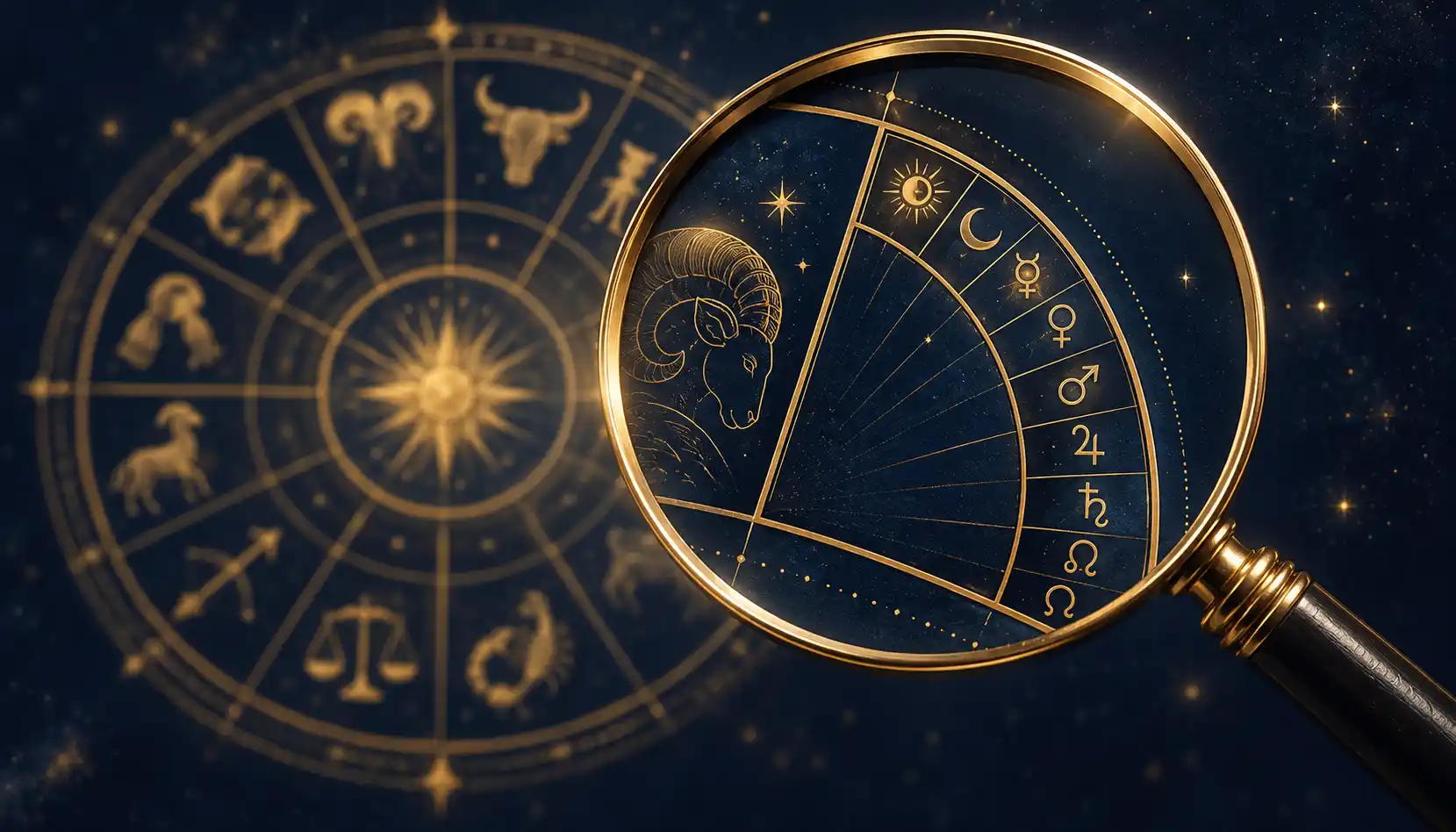
The navamsa (also written navamsha, or D9) is a divisional chart made by splitting each zodiac sign into nine equal parts of 3°20′. It is the most important chart after the main birth chart (D1). Astrologers use it for two things: marriage and partnership, and checking a planet's real strength. A planet that looks strong in the birth chart but weak in the navamsa often delivers less than it promises.
What are divisional charts?
Your main kundli is the rashi chart (D1). Divisional charts (vargas) cut each sign into finer pieces and rebuild the chart from them, zooming in on one area of life. Parashara describes sixteen of them. The most used:
| Chart | Name | Each sign split into | Used for |
|---|---|---|---|
| D1 | Rashi | 1 | Life as a whole, body |
| D2 | Hora | 2 | Wealth |
| D3 | Drekkana | 3 | Siblings, courage |
| D7 | Saptamsa | 7 | Children |
| D9 | Navamsa | 9 | Marriage, dharma, planet strength |
| D10 | Dashamsa | 10 | Career and status |
| D12 | Dwadasamsa | 12 | Parents |
| D60 | Shashtiamsa | 60 | Fine detail of everything (needs a very accurate birth time) |
The working principle: a promise must show in the D1 and be confirmed in the relevant varga. A strong 7th house in D1 backed by a healthy navamsa is a much stronger indication than either alone.
How is the navamsa calculated?
Each sign's 30° is split into nine navamsas of 3°20′ (which is also exactly one nakshatra pada, so the 108 padas equal the 108 navamsas). The count starts from a different sign depending on the element:
- Fire signs (Aries, Leo, Sagittarius) start counting from Aries.
- Earth signs (Taurus, Virgo, Capricorn) start from Capricorn.
- Air signs (Gemini, Libra, Aquarius) start from Libra.
- Water signs (Cancer, Scorpio, Pisces) start from Cancer.
So Venus at 5° Taurus falls in the 2nd navamsa of Taurus. Counting from Capricorn, that's Aquarius, which means Venus is in Aquarius in the D9. Any chart software does this automatically. Knowing the logic just makes the chart less mysterious.
Birth time warning: the navamsa lagna changes roughly every 13 minutes. If your birth time is approximate, read the navamsa planets but treat the navamsa lagna and houses with caution.
Why is the navamsa used for marriage?
The navamsa is traditionally read as the "chart of the spouse" and of the inner, later-life self, the person you grow into, often after marriage. For marriage questions astrologers check:
- The navamsa lagna and 7th house: the nature of the partnership.
- Venus in the navamsa: the capacity for affection and harmony. (Jupiter is also checked, traditionally as the husband's significator in a woman's chart.)
- The D1 7th lord's navamsa position: whether the birth-chart promise of marriage is backed up.
- Malefic or benefic influence on the D9 7th house.
This is why a guna milan score alone isn't enough. It never looks at the navamsa.
What does the navamsa say about planet strength?
The navamsa acts as a quality check on every planet:
- Vargottama: a planet in the same sign in D1 and D9 is called vargottama and is considered notably strong and consistent. It "means what it says".
- Exalted or own sign in D9: a planet weak in D1 but dignified in D9 often recovers and gives better results than expected, especially later in life.
- Debilitated in D9: a planet that looks impressive in D1 but is debilitated in D9 may promise more than it delivers.
A common shorthand among astrologers: D1 is the tree, D9 is the fruit.
How to read your navamsa in four steps
- Note which planets are vargottama. These are your most reliable planets.
- Check each planet's D9 sign for exaltation, own sign or debilitation, and adjust your D1 reading.
- For marriage: look at the D9 7th house, its lord, and Venus. Then connect back to the D1 7th house.
- Look at your current dasha lord in D9 to judge how fully that period can deliver.
Frequently asked questions
What is the navamsa chart used for?
The navamsa chart (D9) is used mainly to study marriage and partnership, and to judge the true strength of each planet in the birth chart. It is also traditionally linked to dharma, the inner self and the second half of life. Most Vedic astrologers consider it the most important chart after the main birth chart.
What does vargottama mean?
Vargottama means a planet occupies the same zodiac sign in both the birth chart (D1) and the navamsa (D9). A vargottama planet is considered strong and consistent, so its results tend to match what the birth chart promises.
Is the navamsa more important than the birth chart?
No. The birth chart (D1) remains the primary chart, and the navamsa refines it. Astrologers read the D1 first for the overall promise, then use the D9 to confirm, strengthen or weaken that promise, especially for marriage and planet strength.
Why does my navamsa change with a small birth time change?
The navamsa lagna moves through all 12 signs in about the time the main lagna moves through one, so it changes roughly every 13 minutes. A small birth-time error can therefore change the navamsa lagna and houses, even though the planets' navamsa signs stay the same.