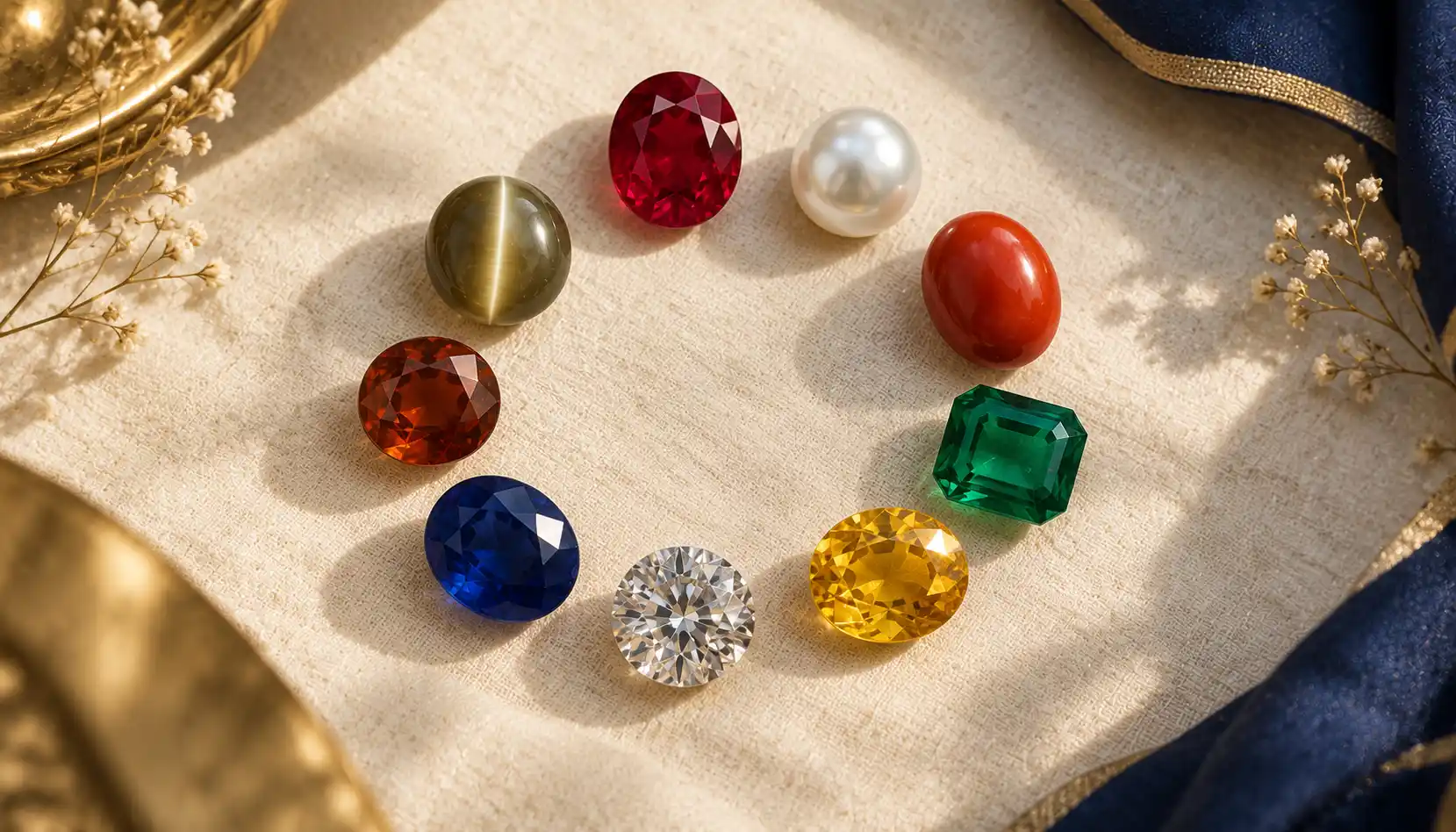
In Vedic astrology each of the nine planets is traditionally linked to one gemstone, the navaratna: ruby (Sun), pearl (Moon), red coral (Mars), emerald (Mercury), yellow sapphire (Jupiter), diamond (Venus), blue sapphire (Saturn), hessonite (Rahu) and cat's eye (Ketu). Tradition holds that wearing a planet's gem strengthens that planet's influence. There is no scientific evidence that gems change life outcomes, so treat a gem recommendation as tradition, not treatment.
This post explains the tradition fairly and then tells you what to watch out for.
Which gemstone goes with which planet?
| Planet | Primary gem | Common alternative (uparatna) | Traditional finger |
|---|---|---|---|
| Sun | Ruby (manik) | Red garnet | Ring finger |
| Moon | Pearl (moti) | Moonstone | Little or ring finger |
| Mars | Red coral (moonga) | Carnelian | Ring finger |
| Mercury | Emerald (panna) | Peridot, green tourmaline | Little finger |
| Jupiter | Yellow sapphire (pukhraj) | Yellow topaz, citrine | Index finger |
| Venus | Diamond (heera) | White sapphire, zircon | Middle or ring finger |
| Saturn | Blue sapphire (neelam) | Amethyst, iolite | Middle finger |
| Rahu | Hessonite (gomed) | Orange zircon | Middle finger |
| Ketu | Cat's eye (lehsunia) | Tiger's eye | Ring or little finger |
Practices vary by tradition and family. These are common conventions, not universal rules.
How are gemstones traditionally chosen?
The key point most sellers skip: a gem is supposed to amplify a planet, not fix it. Amplifying a planet that causes trouble in your chart would, by the tradition's own logic, amplify the trouble. So classical practice is:
- Only for functionally helpful planets. Gems are usually suggested for the lagna lord and the lords of the 5th and 9th houses, or a yogakaraka. They are generally avoided for lords of the 6th, 8th and 12th houses.
- Strength matters. A well-placed but weak helpful planet is the classic candidate.
- Malefics need extra care. Gems for Saturn, Rahu and Ketu (blue sapphire, hessonite, cat's eye) are traditionally treated with the most caution. Even practitioners who use them often recommend a trial period first.
- Timing. Some astrologers suggest gems tied to a helpful dasha lord.
The tradition also links quality and size to effect. That claim is hard to test and conveniently pushes buyers towards expensive stones.
What does the evidence say?
There is no controlled study showing that wearing a gemstone changes career, marriage, health or wealth outcomes. The mechanisms offered (vibrations, rays, energy) aren't measurable in a way that's been tested. People do report feeling different after wearing a gem, which is consistent with expectation and meaning: a ring you wear as a daily reminder of an intention can genuinely change how you act. That's a real effect, but a psychological one, and it works with a ₹500 stone as well as a ₹50,000 one.
AstroCheQ's reports don't prescribe gemstones as a way to change outcomes.
Red flags before you buy
- Urgency or fear. "Wear this immediately or X will happen." No serious tradition says this.
- The person recommending the gem also sells it. That's a direct financial incentive. Get a recommendation and a stone from different people, or skip it.
- Every problem gets a gem. Career, marriage, health and exams can't all be solved by stones.
- No chart reasoning given. If they can't explain which house the planet rules for your lagna, they're guessing.
- Price inflated by "certified astrological quality". A lab certificate tells you a stone is natural and untreated. It says nothing about astrological power.
- Health claims. A gem is never a substitute for medical care.
If you still want to wear one
That's a personal and cultural choice, and many people find meaning in it. Sensible guardrails:
- Get the recommendation from someone with no stake in selling it.
- Make sure the planet is functionally helpful for your lagna.
- Prefer a modest, natural, untreated stone. A bigger stone has no proven extra benefit.
- Treat it as a reminder of the qualities you want to build, and pair it with action.
Frequently asked questions
Which gemstone should I wear according to my birth chart?
In Vedic tradition, a gemstone is usually suggested only for a planet that is helpful for your lagna, typically the lagna lord or the lord of the 5th or 9th house, and only if that planet is weak. Gems for lords of the 6th, 8th and 12th houses are generally avoided. There is no scientific evidence that gemstones change life outcomes.
Is blue sapphire (neelam) dangerous?
Blue sapphire is traditionally considered the most powerful and fast-acting astrology gem because it is linked to Saturn, so tradition advises caution and often a trial period. There is no scientific evidence that a blue sapphire can cause harm or good fortune. The caution reflects the tradition's view of Saturn.
Do astrology gemstones really work?
There is no scientific evidence that astrology gemstones change real-world outcomes such as career, marriage or health. Some people report feeling more confident or focused while wearing one, which is consistent with psychological effects of meaning and expectation. Gemstones should never replace medical, financial or professional advice.
Can I wear the gemstone for my zodiac sign?
Wearing a gem simply for your zodiac sign is a popular-astrology practice. Vedic tradition instead chooses a gem from the full birth chart, based on which planets are helpful for your lagna and how strong they are. The gem for your Sun or Moon sign might strengthen a planet that rules difficult houses for you.